
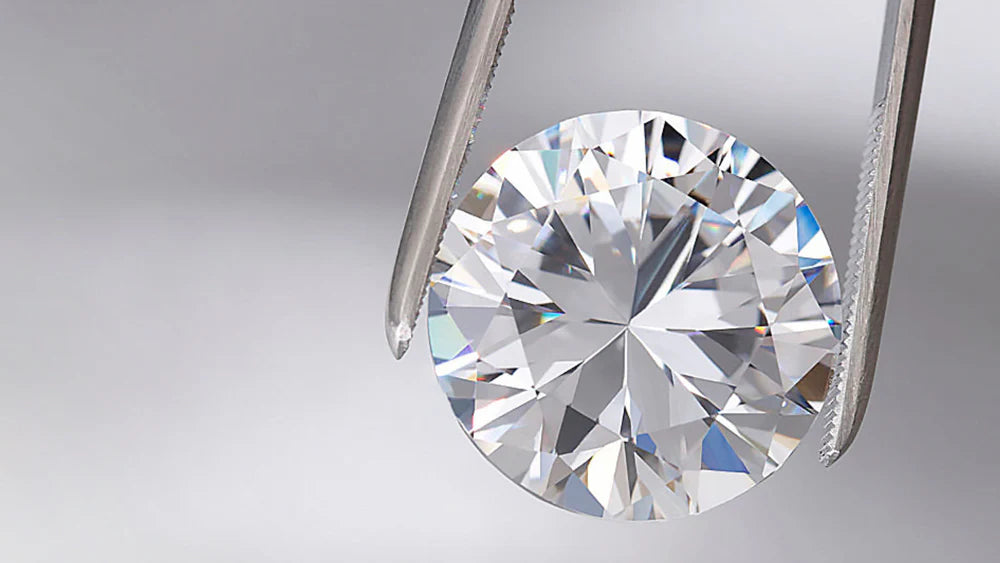
What are lab-grown diamonds?
LAB GROWN DIAMONDS
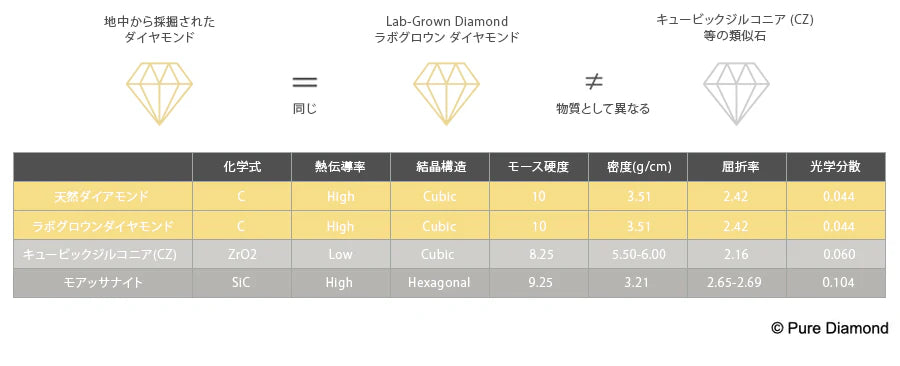
A lab-grown diamond is a diamond created on Earth. Unlike diamond simulants (cubic zirconia, moissanite, crystal, etc.), often referred to as "imitation stones" or "look-alikes," lab-grown diamonds are the exact same substance as natural diamonds mined from the earth, possessing identical chemical, physical, and optical properties. Lab-grown diamonds and natural diamonds are made from the same raw materials. The only difference is their origin.
Since GE first successfully created lab-grown diamonds in 1956, the technology for producing them has advanced significantly day by day. While their primary use was largely industrial, in recent years, the technology for producing jewelry-quality diamonds has also seen remarkable development, making it possible to create colorless, transparent, and very high-quality diamonds. Lab-grown diamonds have established their position in the jewelry market, particularly in the United States, and are attracting attention as a future jewelry material.
There are two main methods for creating lab-grown diamonds: the HPHT (High-Pressure/High-Temperature) method and the CVD (Chemical Vapor Deposition) method.
How Lab-Grown Diamonds Are Made
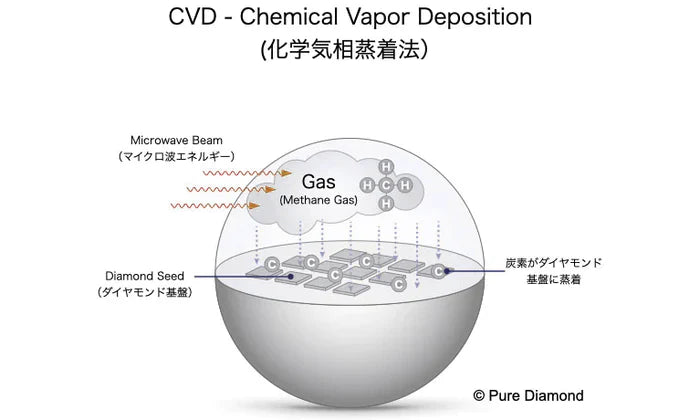
CVD (Chemical Vapor Deposition) is a suitable method for producing high-quality, relatively large diamonds. The growth temperature is relatively high, ranging from 800 to 1300℃, but high pressure is not required.
In this method, diamonds are grown layer by layer on a substrate inside a chamber. By applying energy from microwaves to methane gas containing carbon, diamonds gradually grow on the substrate. The type and amount of chemical impurities can be precisely controlled, allowing for the production of high-purity, high-quality diamonds.
HPHT (High-Pressure High-Temperature method)
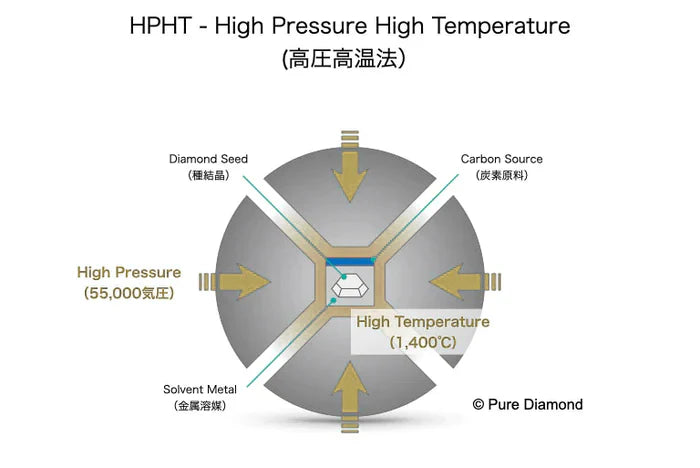
The oldest and most widely used research method is HPHT (High-Pressure High-Temperature). Natural diamonds are formed deep within the Earth's mantle, and this method artificially creates a similar environment to produce diamonds. It requires both high pressure, around 55,000 atmospheres, and high temperatures, exceeding 1,400℃.
Currently, there are three types of HPHT methods: the belt type, the cube type, and the multi-cubic type.
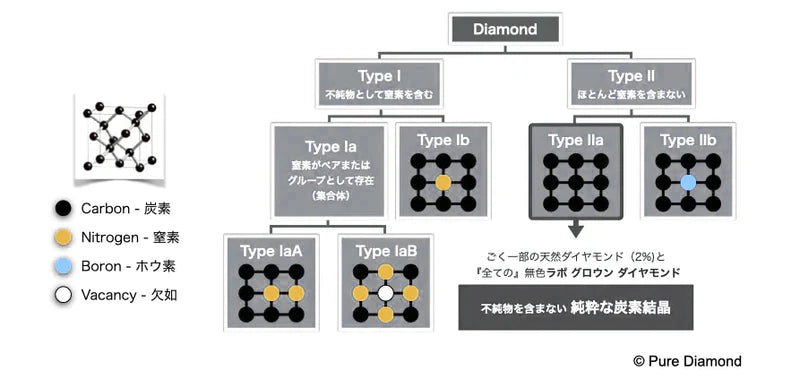
Types of Diamonds
Diamonds are carbon crystals, but natural diamonds that grow in nature often incorporate impurities during their growth process. Most of them grow by incorporating nitrogen, a common element on Earth.
Diamonds containing nitrogen are classified as Type I, while those containing no nitrogen at all or only trace amounts of nitrogen are classified as Type II. 98-99% of natural diamonds are classified as Type I. Very rarely, Type II natural diamonds exist. They are said to possess exceptional beauty due to being pure carbon crystals with almost no impurities, and larger ones, in particular, are traded at higher prices than Type I diamonds.
On the other hand, colorless lab-grown diamonds produced in a completely controlled environment are *all* Type II, meaning they are pure carbon crystals with no impurities whatsoever.